reabc/Six Essays by California Drug War Prisoner Eugene Dey/Six Essays by California Drug War Prisoner Eugene Dey.pdf
Web PDFImposed PDFRaw TXT (OCR)
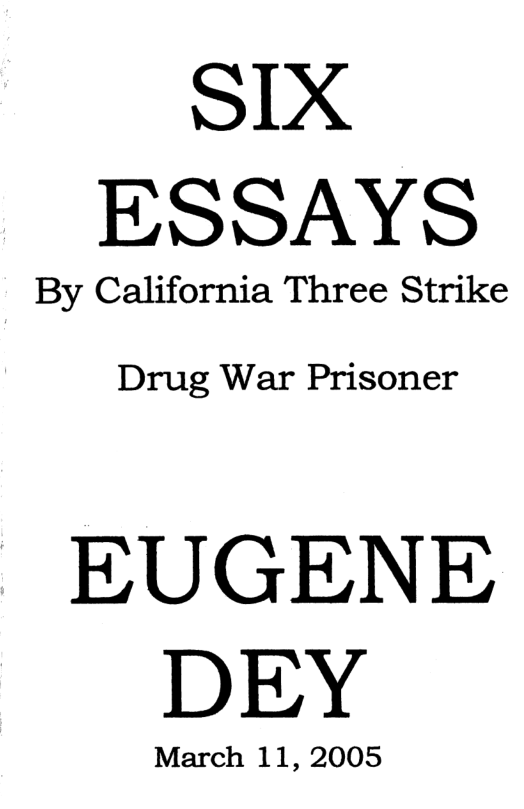
SIX ESSAYS  By California Three Strike  Drug War Prisoner  EUGENE DEY  March 11, 2005
Eugene vey -37364 z o721  ?.0. Box 2210  Susanville, A 96127  WEHE CAUIFORNIA PRISONCTAT AND NOTHING MORE TO GIVE®  ny Eugene Alexander Dey  Governor Schwarzensgger campaigned on the platfors of cleantng up how politics are conducted in California. Due to » budget deficit of $14 billion, no state agency vill be able to escape across-the-bosrd cut-backs. Mowever, corrections has an unholy advantage over all other segments of state governaent.  The California Dapartment of Corrections (COC) is an unsanageable conglomerate of 32 state prisons, vith  $5.3 billion budget. The Schwarzenegger adainistration has oftered  nusber of cost-cutting ideas -- from releasing insates early, revamping the parole systos, and closing down prisons.  There are two opposing school  ~of-thought on the issue  of drugs, crime, and public safety in California.  0 one side are the bipertisan proponents of the drug var and prison industrialisn, They are dogmatic in thetr support for all manners of unforgiving criatnal Justice precopts, no aatter how 111-conceived or ineffective.  These advocates of heavy-handed punishaests are vell-tunded and Lead by the California Correctional Peace Officers Assoctation (CPON). They are brilltant i thets tactics by Lavesting in candidates on both sides of the political spectrus. With thetr annual $20 aillion var chest, they have 5o equal.
On the other side of the debate are the anti-arug var, 3 pro-husan rights opponents of the American prison phencmenon L  those of us locked-up, our loved ones  and a very small  number of dedicated prisoner-advocates. Our allies are generally  volunteer activists who operat  on shosstring budgets. on its face, the CCPOA 1s simply a union looking out for the interests of their constituents. Wowever, their succes:  have created a power-vacuun. Corrections is an industry lavishly rewarded for a genaration of miserable recidiviss rates, scandals, and  controvarsi  They have been alloved to expand and grow despite thetr fatlures.  e conteaporary crimtnal justice ideology of punishment over rehabilitation relleves prison administrators from the  -oriented  burden of being required to manage in a result:  atnosphere. This has allowed the prison system to concentrate  its resources on their guards, as opposed to the inmates Potnts to consider  ~ Prom 1984 to 1994, tventy-one state prisons were built and only one state university.  - College fees are raised every year and education budgets for students X-12 alvays get hit hard.  - Prison guards are paid better than all state educators,  including tenured CSU professors.  - Prison vocational classes were virtually eliminated when  the COC had ‘to lay-off workers. It vas determined that correctional educators —- COC eaployees who actually provide  meaningful service -- mot guards, were expendable.  - The CCPOA negotiated a 34 percent pay raise in 2002 when the state vas in the middle of a fiscal crisis.
As far  corrections go, the COC 1s too large and the 4 unton representing the 29,000 prison guards too powerful.  A nusber of things have to happen if the COC is ever to assume their place alongside, not sbove, other state agencies.  - ALL nonviolent drug offenders, including second and third  strikers, need to be placed in comsunity-based treatment  factlities. Incarcerating drug offenders in $30,000 a year prison beds for lengthy and life sentences meeds to come to  an end.  - Change the state’s rectdivist sentencing scheses so that Lengthy and 1ife sentences are only given to violeat cristnals and sexual predators.  - Paraanently close-down a nusber of prisons in response to thase moves. Segin with the older, dilapidated prisons -~ but don’t stop there.  The swestheart deals the CCPOM received for gensrous campaton contributions need to be identified and undons. These  are inexcusable quid pro quos.  Case 1n potat, COC overtine: Recalled Governor Gray Davis vas unconditionally indebted o the CCPOA for millions in campaign contributions. In addition to giving the guards a $1 billion pay raise in 2002, he restricted a varden’s pover to discipline guards vho abuse the proca:  of calling in sick.  The COC vas already a state agency depending heavily on overtine. Davis allowed the COC to becoss even more so dependent on overtime by knowingly providing rank-and-file guards the Pover to writs their own rules. Mecause the union runs corractions, not upper echelon adainistrators, chronic overtise abuses result in the department going over budget by half of 2 billion dollars a year. This is how a prison guard is able  to earn a salary of over $10,000.
While the Schwarzenegger administration talks about inmate population cuts and prison closures, California is the recipient of a skewed state government. And the guard’s power-base is S still unmatched. A whole generation of CCPOR-owned lawmakers are still in Sacramento waiting to do the guard’s bidding.  It is not my position that corrections is the only problem plaguing our society. Nor do T attempt to diminish society’s Justifiable concern with public safety. But the correctional spectal interests have been a corrupting influsnce for so long somsthing drastic needs to be done.  s an inmate I’ve 1ived under the reign of the CCPOA for over half a decade as a noviolent three strikes drug offender.  I see firsthand vhat soclety cammot. T ses an army of overpaid correctional officers absolutely bloated on government funds. They own this state and think it’s funny. They need to be placed on halt rations, not us.  California insates as a demographic have mothing else to give. We are forced to spend the rest of our lives in the  Gulags of pillaged husanity. The guards have taken it all. It s through mismanagesment and greed that a 15.3 billion state agency Looks to the inmate population vhen pressured by the legtslature to trim costs, They extort us -- ve are economic hostages. ALL the noney ve receive from our loved ones and the collact-only telephons calls ve place are both heavily taxed.  Currently, 33 percent is deducted from all incoaing moneys  which will increase to an astounding 55 percent in mid-2004.  ALL of it under the guise of restitution. The telephone service providers have been avarded the lucrative California prison contract without even having to place a bid -- with the COC receiving tens of aillions in kickbacks. We receive the worst aeal tmaginable due to this "no-bid" arrangement.
These are merely a few examples. Welcome to the world é of the California state prisoner vhere cumlative injustices are inflicted on the entire population who simply have no voice, no rights, no representation.  As state prisoners in the California prison systes, ve  are mere fodder. We are the king’s peasants and treated  accordingly. Taxstion without representation has a reneved  meaning for 160,000 of us and our loved ones. Oppression comes to mind.  This s not just about budget problems, pork barrel This 1s  this 1s about peopls  about soctety.  As a member of a voiceless population, I spesk for all when T say: “Enough is enough. We have nothing more to gi: You’ve taken it all. Give some of it back and leave us alone.”  When looking for some other miserable demographic to demonize —- the prisoncrat should simply look in the mirror.  “CALIFORNIA’S THWEE STRIKES AWD THE NONVIOUENT LIFER"™ By Bugene Alexander Dey  They say a criminal alvays returns to the scene of the ertn  Approaching the place whers T vas arrested near the Antelope exit on I-  0, an enormous sense of loss overvhelned me. I felt like I was viewing the spot vhere I vas killed. This  s the second day of a two day journey froa one end of the state to the other. Shackled at the waist and again  at the ankles, I was a state prisoner in transit from a  correctional facility in southern-California to another in  Susanville. The experience of seeing my hometown vas almost oo much to bare. It has been six long years
Any velony 7 T an a three strikes drug offender serving a sentence of  26 to 1ife for possession of methamphetamine. Ten years into  this heavy-handed social experiment and stories like mine are all-too-comon. Regardless of what the proponents of draconian legislation profess, my only crime is I am a man with a past. People like me are not criminals. We are collateral damage  in the var on drugs.  Thres strikes is not an entirely misguided concept. If someone has perpetrated three acts of violence on three ssparate occasions, then by all means bring dovn on them the full weight of the criminal justice system. This is more than enough for any soctety to endure. At some point, enough is enough.  Yot, California has gone too far. They included "any" folony within the language of the statu much ground. If someons has two or more serious or violent  This covers too  felony priors and find themselves arrested for a bad check, a drunk driving, or a drug charge they are automatically eligible for a 1ife sentence. Only California applies this sentencing mandate in such a manner. Serfous Criminalfty and Waking a Break My background is comnon among three strikers -- it involves robbery, burglary and drugs. My introduction to the criminal justice system began in 1984 vhen T vas 18. An accomplice and T robbed a North Highlands conventence store. No one vas injured. I received a year in the county jail. In 1988, T received a 12 year prison term for two separate idential burglaries. Again, no one vas injured. Since addiction to methamphetanine was the root cause of  my deviance, I chose to rehabilitate myself. At that time,
state prisons offered a nusber of incentives and programs  b4  T took advantage of thea all.  By the time I paroled from prison in 1994, I vas college oducated and a published writer. I had made a break with By antisoctal past and left prison a better man. The felontous youngster who committed those crimes no longer extsted.  The college prograns then-offared by the Caltfornia Departsent of Correctfons (COC) provided one with the opportunity to change for the batter. A college education gives a convicted intlate back fato soctety. That is exactly vhat I aid. I closed one chapter and started a new  felon an opportunity to  Upon release I studted sociology full-tive at CSUS while I owned and operated a small construction cospany. I becama & full-on multitasker and vas moving up the soctosconoaic ladder.  Sadly, after over seven years of sobriety, I relapsed. In & soment of weskness, I started using again. In doing 8o, I reavakened a dorsant dlsease.  one night in 1998, I vas pulled over by the CHP who atecoversd a small amount of methamphetasine and marijvans in By vehicle. Ever since that fateful night I have baen treated like s Killer. ALl I aid vas relepse. In my addiction, I bothered no one.  While all nonviolent three strikers have thefr ovn  individuslized stories, we all sutfer from precisely the same  injustice. Tt is simply vrong to incarcerate someone for life Vhen they have not comsitted a violent orime. At vorst, ve should be in community-based trestment facilities by virtus of our dectstons to discontinue comitting serious orize. We 40 not belong in prison -- espectally not for 1ife.
correcttons 9  The CDC of today barely resesbles the prison system T entersd 1n 1988, Almost every program of consequence has been elininated. Post-secondary correctional education vas canceled in the ’90s along vith fanily visiting and velght training.  The few resstning vocational prograss have recently been atocontinued. And visiting has been cut-down to only two-days a week.  Furtnernore, there are tens of thousands of 1st and 20d strixers serving lengthy sentences. Wany of them are nonviolent offendars 1ike ayself. While they might not be serving ifs, theix prison teras have been doubled and they must serve 80 percent to 85 percent of their sentences. Thus, correctional factitties across the state are teeaing vith nonviolent Tst, 2nd, and 3rd strikers vho are not offered any meaningful prograns or tncentives to better theaselves.  Treataent. for the dfsea:  of adaiction is sloviy being enbraced by correctional administrators. The COC has begun to offer substance abuse programs. Because only 8,226 treatment beds are available to serve a population of 160,000 inmates,  only a small percentage are eligible. To receive 1ife for adaiction fs bad enough. The injustice  1s anplified vhen we are excluded from both community-based  and tnstitotional trestaent. Contemporary correctional methodologies are ot based on logic or solid evidence - but have becose & mosatc of miserables. The Suprese Court and State Government  Thousands of us, our loved ones, and supporters vers hoping for a favorable ruling in Lockyer v, Andrade and Bving v. californts (2003). Under californta lav, petty theft, a nisdossanor, can be elevated to a felony. This is the most
extrens example of the toughest sentencing lav in the Aserican crintnal justice systea. lo  Ina s to 4 ruling, the Supreme Court held that sending potty theft offenders to prison for 1ife did not violate the 5th Amendment’s ban against cruel and unusual punishoent. Wad the three strikes been successfully challenged in Andrade and Bving, many of us would have tried to expand the scope of the dectston to fit our cases. This just wasm’t meant to be.  Generally, the high court avoids usurping a state’s sovereign right to create their own lavs. Thus, state legislatures are responsible for fixing their own lavs, not the courta.  ALL over the country state governsents are modifying and abandoning many of thefr toughest measures. Even Michigan and  New York, who had some of the most severe anti-drug measure  in the nation, have modiffed their sentencing schemes. State governments are coaing to the conclusion that being smart-on-crine means they cannot continue to indefinitely support  mammoth prison systeas.  With Calffornta lavmakers among the toughest in the nation, there 1s a lot of pressure for them to get smart as well. Whether or not they do so remains to ba seen. Stx Don and Twenty To Go When the prison bus pulled fnto Susanville, I vas in bad shape. Wnile the aches and pains from a 12 hour shackled bus ride would heal, psychologically, I wi  a mess. The trip through my hometown of Sacramento exacerbated the fact I’  not even eligible for parole untfl 2024, The painful realities of my situstion stay vith me morning, noon and might. The ghosts fron my past and present torturs me in my sleep and stalk me 1ike a Grim Resper throughout the day. Welcome to my world.
Whether 1t be by voter-initiative or through the  1  legislature, three strikes neods to be changed. The goal should never be to  ¢ free predators and violent recidivists, but to close an ugly chapter of Californfa history whers both shopliftars and drug addicts receive 1ife sentences alongside murderers and child molesters.  While T an sure an avalanche of drug war advocates would atsagres, but T am not a crimtnal. I’m Just some guy vho wants €0 give his elderly mon a hug and a ki  a freeman before  she dtes. Ts that too much to ask?  Life For Nothing When Child Predators Go Free  e Suprece Court’s decisions in Andrade and Fuing surprised hardly anyone, vhile the holding in Stosner literally came out of nownere. The proponents of maintaining the thres strikes status quo argued that a litany of monviolent third strikers vould be unleashed on society if the law vers upset in any vay.  Public safety was the battle cry. Yet, just a few months laf  that same court released about 800 child molesters on that very same soctety. This simply fails to make any sense.  The Stoaner court heard arguments on a stat  s linits tn  its ex post facto zeal to protect its children, while the Andra  and Ewing court had to decide whether three strikes violates  the Eighth Amendment’s ban against cruel and unusual punishment.  One would think the nonviolent third strikers would stand a better chance than the child rapists.  Sex offenders committing heinous acts generally fuel  aracontan sentencing statutes. Most of us serving third strike  Life sentences have absolutely no sexual deviance in our  backgrounds vhatsosver. What makes it all harder to accept  1s the fact that child predators received constitutional relief
while us nonviolent nobodies will pay with our live  for victimless crimes of insignificance.  The Narrouly Divided Supress Court  The philosophical make-up of the Supreme Court is split aoun the middle. Chief Justice Shenquist and Associate Justices Kennedy, Scalia, and Thomas comprise the right, vith Assoclate  Justices Breyer, Ginsburg, Souter and Stevens on the left.  Justice Sandra Day 0’Connor is the sing vote on mearly all “e7 decisions.  These justices can be counted on to assume their positions ¢ predictability as O’Connor inevitably decides if a sentence is cruel and unusual punishment, whether the statuts of Linitations can be extended, or, in cases of the death penalty,  it someone lives or dies.  With the Supreme Court so narrowly divided, there is a Lot at staks  For President Bush’s Republican Party, the 2004  lovenber election holds the potential for the winner to appoint  tuo or sore justices. For the warmonger Bush, it is his duty  s a right-uinger to £ill the Suprese Court with yousg  conservative  Since the Republicans control all three branches of the  fadaral government, the only check remaining on the Bush  administration is the filibuster. To the chagrin of the  Republicans, Enrique Estrada, nominee for the D.C. Circuit, withdrew his name from consideration on September 4, 2003, He vas considered on the fast-track to the Suprese Court and a stealth conservative.  With one Bush fast-track nominee dova and at least two others to go, the Democratic filibuster continues in the Senate  as the high court produces a series of 5 to 4 dectsions.
Total Recall  California Republicans are trying to steal the Governor’s ottice 1  than a year after Gov. Gray Davis vas reelected. T am no lover of Davis. We has and continues to be a staunch aduocate of overly harsh punishaents, prison industrialisa, and undying support for the drug var.  Davis has an unholy alliance with the California Correctional Peace Officers Association (CCPOA), the rich and powerful union which represents the interests of the prison guards. They serve as the financial lifeblood of maintaining huge prison systems no matter what it costs. The CCPOA buys politicians and influence the vay the Mafia used to buy judges, prosecutors and cops -- with dirty scney.  Howevar, despite obvious disdain for a bought and paid for prisoncrat like Davi  the recall of his election s absurd. The problems in the Golden State are myriad. The recall simply does not go far enough. Too much blame is placed on Davis,  a Democrat, when the Republicans run the entire federal government -- which is also in dire financial straits.  If anything, the current recession is the fault of the Bush adninistration for lauching a var in the Widdle East when domestic matters screaned for attestion. Only a Republican would lead a nation into a quagaire like Iraq and then attempt to justify it with powerful presidential propaganda. Bush is better suited to Captain the Titanic than serve as president.  He should be impeached.  For a Republican to clain he could solve California’s budget deficits when both houses of the state legislature are controlled by the Democrats is one of the biggest lies ever told. Since the Republicans brought the recall into fruition, Democrats and Republicans will remain at war in the Golden State for quite
sonetine - especially if a Sepublican vins the recall electien. Jow 1t a1 makes sanse aa T ay vith the zest of my 1ata !  for the crime of nothing. Having to pay sy debt to this insane  soctety 1s the cruslest joke of them all. Only I em sot  laughing. If I deserve 26 years to life for a monvioleat drug of fer  then all government officials dessrve to be recalled.  “rhe Industry of Desth Has Outlived It’s Usefulness®  By Bugene Alexander Dey  merica should abolish the desth penalty. It is an ugly and mean-spirited lav. Moreover, it is simply vrong to trust Aserican trial courts to deternine if one should live of die - roqardless of the offense. This includes the recest abductfon - and murder of the 11 year ol girl in Sarasota, Florida.  » capital corise brings out the vorst in society. Wirder in any forn is a terrible thing. Even vorse are overseslous prosecutors and lav enforcesent officers who go too far in their afforts to solve the crise and severely punish the offender.  At best, a guilty killer confesses on his owa, resoving any doubt as to guilt. At worst, an imnocent person is sent to their death. Too often the phenomenon of actual innocence 1a caused by questionable testimony, jail-house informants vho ahould naver be trusted, and overly suggestive idemtiffcation procedures conducted by bias lav enforcesent.  The only real chance the accused has in a capital trial Ls the ability to retain top-notch legal representation. Justice 4s not cheap in Anerica.  Don’t forsake our Drug War Brothers & Sisters!
Scott Petarson, who is accused of killfng his preguant ¢ vife and facing the death penalty, vas able to afford noted trial attorney, Mark Gerragos. No matter how the case turns-out, Gerragos 1s a skilled litigator who will ailigently represent the accused.  In the adversarfal testing process, both the prosecutor and the defense attorneys ave opponents. Each have their roles. The prosecutor is the seekez-of-truth and represents the interests of the pecple. The defense attorney is duty-bound to challenge his opponent at every stage of the proceedings.  Most capital defendants are poor, uneducated males, and atsproportionately African American. The quality of appointed representation indigent defendants receive is not even close to what is needed to ovarcome the efforts of pro-death prosecutors. While Peterson will receive the best defense only money can buy, the poor get what they alvays get -- the bare minimua,  1 have a hard-tise finding syspathy for someons who viclously murders, rapes and molests. Maybe if the system could guarantee perfection, perhaps death would be varranted. However, the American system of justice is far from perfect. It’s  mosatc of miserables. America’s courts are busy processing an endless supply of drug offenders. Due process, adequate reprasentation, and other constitutional safeguards becoss distorted in the fast-food mentality of Aserican justice. It is foolish to believe a vell-oiled incarceration machine should be trusted to fairly and justly try a capital crise —- 100 parcent of the tiss. he option of 1ife vithout the possibility of parole (UWoP) 1n lieu of the capital puntshuent is viable. As an insate law Glork 1n a saxisus security prison, T befriended many LWOP
Lnmston who at cue potat. faced desth. 0nce theis sopesis re exhasetad, the seebisacion sete-in that they vill never sea /6 the streets again. What soctety doss ot e is the dead-to-  tha-vorla Look in thets eres  it 1a not a pretey sight. Lo 1s & very harsh penalty.  It costs roughly 52 million o try a capital case in Californta, six tises higher than a non-capital trial. A desth rov insate receives an automstic appeal that can take decades - all at the expense of the taxpayer. That very same inmate given the lesser penalty of LWOP is only guarantesd a one-shot appeal that is usually finalized in a couple of years.  As a Californa prisoner serving a life sentence for a nonviolent drug offense, T have firsthand knovledge how justice works for those of us on the botton rungs of society. We get what ve pay for  a fraction of what a rich man gets.  As California prepared to execute death rov inmate Kevin Cooper, T had no way of knowing 1€ he really killed that famtly in Chino Hills in the esrly ’80s. No one does. But I do know  one thing -- capital punisheent no longer has a place ia a civilized soclety. It had a purpose in the mid-19th Century, and 1t case sviftly at the eod of a rops. In modern times, the death penalty is an sbosination that needs to be expunged £ron the law books forever.  EUGENE ALEXANDER DEY is a three strikes offender serving a life sentence in Susanville State Prison. He is a collegs educated freclance writer who represents himself as he challenges his conviction and sentence.  EUGENE AUEXAWDER DEY is an nonviolent drug.effender serving three strikes life sentence at the state prison in Susanville. is also a Sacramento native, a freelance writer, and a former  udent at CSUS who majored in Sociology with a concentration  in crime and deviance, Currently he represents hinself in pro  5o as he challenges his conviction and sentence.
17  JUSTICE IN THE GOLDEN STATE  8y Eugene Alexander Dey  Two landmark 5 to 4 Supreme Court decisions came-down in  2003 that stabbed my conrades and I in the heart. Thousands of us are  rving life  ntences for nonviolent crimes while Chi1a sex abusers are barred from prosecution, exonerated and liberated. Hothing makes sense anymore. Vith California’s racall just around the corner and the 2004 election cycle kicking into gear, T cannot escape the fesling that we are all going to dte in prison because of a justice system that has been pernanently compronised. These Are The Facts  on March 5, 2003, in Lockyer v. Andrade and Eving v. California, the Supreme Court of the United States ruled it uas ot cruel and unusual punishaent to send minor crimdnals €0 prison for life  Three strikes came into being in 1994 after Richard Allen Davis, a sexual pradator with a long rap sheet, killed a 12  year 514 Polly Klaas. California lawmakers and voters quickly adoptes an all-inclusive repeat offender law that literally inclided "all” offenders.  Ten years later, even though early indications ad not 1ook 9004, we hoped the Supreme Court would do the right thing and rule California was going too far in its desire to crackdown on violence. We were wrong.  “nis court has a longstanding tradition of deferring to  state legislatures in making and implementing such important policy decisions,” wrote Sandra Day O’Commor for the mejority. She Lied.
Then, on June 26, 2003, in Stogner v. California, the high couct struck-down a 1993 law which alloved the prosecution of child 2ol  aca vhen the statute of limitations had atresdy (& expiced. Many of those prosecuted under this lav had comitted unspeakable acts. Marion teynolds Stogner vas cosvicted of ropestedly raptng his daughters from 1955 to 1973.  At a glance, this child sex crime lav seems like & Justifiable concern about child molestation. After all, sex  offenders are often brilliant in masking their deviance as they victinize a helpl  s demographic. Child molesters are considered  monsters.  However, the Supreme Court held that California’s 1993 chila  x crime law failed to come within the retroactivity Limits of the Constitution. In cases of child molestation, unlike sending minor criminals to prison for lifs, a state is  not. aluays able to change its laws.  "The COC And eaningful Access To The Courts®  By Eugene Alexander Dey  Even though the Supreme Court held prisoners do not have a "reo-standing right” to a lav library, prison systems are  st111 obligated to provide inmates with meaningful access to  the courts. (See Lewls v. Casey (1996) 518 U.5. 343) “Each factlity shall provide materials through its law  Library to provide meantngful access to the court:  " (15 cor § 3122(a) Therefore, meaningful access is achieved in the  California Department of Corrections (CDC) when a facility  Library 18 stocked with the lengthy inventory of legal materials Listed in DOW § 53060.11. Further, the DOW states these
satertals shall be kept currest and " contiming subscription ahall be matntained...* (0OM § 53060.12.) 9  condition issues to the federal courts. FPurther, state habeas rule  o not require a filing fee. Coples of 6028, IAC agendas  and minutes (if available), declarations, and any other  support1ing docussatation should be appended to the petition. A separate memorandus of points and authorities should be propared as vell.  The dectston to proceed to the state or federal courts should be vell thought out. If feasible, numerous inmates who are meabers of the group 602 should bring forth a musber of  court challenges to put as much pressure on the COC and offending institutions as possible.  For prisoners already litigating claims in the courts, especially under 28 USC § 2254 (habeas) or 42 USC § 1983 (civil), they should motion the court for appointment of counsel. The movant. should include the same above-nentioned attachments and Point tovards the correct authorities authorizing the court to appoint counsel. Additionally, the movant should ask the court to order the COC to bring their collections into compl1ance.  Because of scarce tax dollars, and the bureaucratic atsobedience displayed by the COC, this particular prison condition needs to be challenged on many fronts -- espectally behind the vall.  Meaningful Access Stands dsIs  After Lewis v. Casey, supra, the COC attempted to relieve themselves of the duty to maintain nuserous legal collections 1n each of their 32 prisons.  In Gilmore v, California (9th Cir. 2000) 220 ¥.3d 987, the Winth Circuit ordered the district court to conduct an
20  evidentiary hearing 8o the COC could davelop a comstitutionsl alternative to the decades-old practice of maintaining expensive Lav 1ibraries. The COC inevitably abandoned their efforts in 2002 because they could not show the court how they would mest thetr constitutionsl obligations absent the updated materials. (see stipulation in Gilsore v, Californis, Wo. C-66-45878-81 (0.5. Dist. Ct., W.0. Cal., April 6, 2002)  Despite the COC’s unsuccesstul legal challengs, the collections of legal materials throughout the nation’s largest prison system have fallen into various stages of disrepair. Since budget deficits are the cause, the problem is likely to get worse before it gets any better. Challenging the COC  1n order to begin a serious challenge to this anconstitutional prison condition, prisoner litigants should begin by £1ling individual and/or group 602s. Moreover, Inmate Advisory Councils (IAC) should include this issus on their agendas in order to show a reviewing court that local efforts are fatile.  stat  habeas petitions would be the obvious choice because of the time-consusing and convoluted nature of bringing prisen  UEAVING PRISON A ETTER WAX By Tugens Alexander Dey  Into The Selly of the Sesst  In 1908, as & tuenty-tvo yesr old high school dropout, I vas ready to make a bresk vith ay past. Althoush I sever Antendad 1t to be as such, T bad becoss & violence-prose drug addtct vith a telve year prison sestesce.
Ae much as T hate to adait it, vhen T wvas younger, I hed 2| issues. o be perfectly honest, T still do. T guess, in some ways, T alvays vill. Osspite these dystusctions, I coss to you vith how T transformed ayself iato a marketable product. I found a vay to save mysalf from syself despite myself.  It vas & resl essy dectsion. T took a loag look arousd ay new eaviromment, I took an even longer look at myself, and dacided to sake a 160 degree change. I ves not happy. I knew ay 11fe vould continss to be & mosaic of aiserables if T dida’t aake o nasded change.  A Ra-taveation of Selt  ha key to change is to lavest ia stresgths vhile Adentitying vesknasses. If you abuse drugs and alcchol, have a poos vork history or  record of robbing asd stealing - you have some serious weskassses. TYou have to decide if you vant to 1ive or dis. To live tha 1ife of somsons who isn’t willing to work for & 1iving is mot living at all. It’ dasd and not even knowiag 1t.  I renventsd ayself. I changed. I spent my time avay from soctaty bettering ayself. I vas so confused and esbarrassed for alloving this to happen that T decided T would never allow  ay weaknesses get the battar of me ever again. I becase a  11ke betng  tiroless taskmaster. I strove to build a better aen vith & supachusan work-athic.  o make such 2 move for the bettar vhile iscarcerated is often an individuslized sojouen 1sto volustary solituds. In such places, the teaptation to further cae’s deviasce s peer pressuce of the worst kisd. Individuls become targets as the popalation separate themselves into alliances alosg ethaic and geographic lines. Celsbrating ona’s daviance takas precedence.  Under such pressure it takes a traly strong iedividusl to stand alons.  I made a nusber of moves. I was able to earn a college Gogres. I quit smoking clgarettes and abstained from drugs.
I bagan to do things vith seriossmess and Getarstmatics. 22 Suddenly vords 1ike perseverance, honor and integrity begen %o mesn something to ss. I transforsed myself isto a rume and & vockout, junkie.  T vas stacving for knowladge, becess & voracious reeder and developed 1ato & writer. I wrote lettars, stocies and articles to the point of exhaustion. T even began to keep @ Journal. I 214 the things T vould never &0 back in my netghborhood. I truly vent through a metamorphosis.  Sarving as unknoving role models vers sy fallov coavicts. he vast sajority of thoss who populate & correctional factlity are taxtbook examples of vhat not to be. Fev prison populations are able to escape the clutches of the doveward spiral. I used those unfortunste 1ndividuale who could mot find the wharevithal to break avay from themsslves — as onstast resinders.  T mbraced a reverse idsclogy. Sehavior my nefarious constituants considared sorsative, T choss to label tahoo and shunned. Sacking cigarettes, doing druge and getting tattoos becase the rites of passage iato the populatios of hopalessncss. Thesa axe the gatevars which retard ose’s sbility to iadeatify the need to change and grov. Prisen s an ugly word.  Change 18 & A1Fficult endeavor Lf cue rafuses to seek the truth. The ansvecs to many of ur probless are right in front of our faces. The truth lies in the eyes of that tricky davil staring back at you vhen you ook 1n the mirrar. Wo coe reslly Knowe you 1ike you do.  1t one vants to eajoy a decest 1ife - whether 1t be on  the tnside or the outsids - then ne has to be villing to vork hard. Por thoss of ua vho have already msde mltiple sistakes in 11fa, ve have to work harder than everyons else. Tt is through repetition that the rigocs of doing the right thing  becose easter over tiss. That 1s, 1€ one vants to coms back £rom the desd.
Saying good bye to yourself, as painful sa that may bs, 2.3 ia the svestast of fareells. The joys of reiavention are what open the doors to opportusity. Thess are the ssss docrs closed for those vho have besn unsble to seke that brask on their ova.  Fatlure 1s assured by a belos-sverage vork-sthic. Ve continue to avest in corrupt and self-dastructive behavior that has ot served us vell. Thase are the hells through which v pass on our Joucneys into the heart of recidivistic darkness.  ALL of which case to se in an dpiphany. It sesmed as it I Loarned as much overnight, in some god-awful priscn call, at oy lovest mosest. T looked arousd at the meager resources oftared by the priscn and took full advantage of thes "all® in a santc amalgam of guilt-ridten overcospensation. I reslized that T could do saything. Wy failures motivated ms. Hothing could stop se. I learned valking on vater is not iagossible 1€ one has to get sosevhers real bad —- and I mean 20 disrespect.  That 1s one of the keys for those of us of & like-aind. Zavesting in what is right and valking foraver sway from what is wrong. That s what wust be dous. If one vats it bad anough, then one can make 1t happen.  An Opuardly obile Assiatlation  For all my hard-vork and determination, T truly left prison on a roll. This ves 1994 and T vas twenty-eight years old. I vas collage educated and a recestly published writer. I had 4 boty chiseled fron heart-pounding workouts. I had a fist £ull-of dresss, & full-on gume-ples, aad not & lot elss. But I didn’t nesd anything else. I took my taskasster vork-ethic I davaloped in prison, along with my short-, mediua, and long-tarn goals, and applied thea to the world beyond the vall.  2 soon as T got out, I put into action years of plamnisg. In adaition to making hoge sacrifices to start a comstruction company, T sisultanscusly west to college full-tise as vell. This vasn’t se leaving priscn isto the aras of opportuaity.  This vas =y implesanting & step-by-step plan formulated yesrs betors,
A Non-traditional Racidivist  Mot all stories have a happy ending, though. In addition tar from parfact. Tou see, with Ay Legendary vork-sthic and all that T vorked 5o hard to achieve, I vas atill a drug addict. I relpased. In all ay self-imposed resteents of gosl-orientation, in hindsisht, I dida’t reslly Look long eaough at ayselt.  I vas a tunctioning addict. In California, for scas of us, that is all 1t takes —- three strikes and you are out. That 1s exactly vhat happened to me, I got struck-out. For a couple hundred dollars worth of drugs, I recelved s life  to betng many things, I  sentonce. Nonsthaless, that is ay problen. I have to live with my atatakes for the rest of ay life. And that is vhat I &  Ilive. I refuse todfs. I refuss toquit. Itrlysss taskaaster vho spends asch day vriting, stadying, exarcisiog - and practicing Law vithout a licease. It is sy duty ss & S0ldier 1n the arug var to fight the good Hight.  I€ you ace getting out next year, ia tan years, or sever at all, 1t shoulda’t matter. For sose of s, change is the nacessary break vAth & past that has secved a8 the basis for Annunerable sorrovs. Take sy story aad Go oue step further.  Are you villing to aske that break and refuss to be weceg the valking dead? Don’t shov me ... show yourself.  EUGENE ALEXANDER DEY is an nonviolent drug offender serving a three strikes life sentence at the state prison in Susanvill 15 aleo a Sacramento native, a freelance writer, and a former Student at CsUS who majored in Sociology with a concentration in crine and deviance. Currently he represents himself in pro a5 he challenges his conviction and sentence.  Eugene Dey P-37864  s SOUTH CHICAGO Siimine, ‘on o612 ABC ZINE DISTRO  PO BOX 721 HOMEWOOD, IL. 60430
SIX
ESSAYS

By California Three Strike

Drug War Prisoner

EUGENE
DEY

March 11, 2005
Eugene vey -37364 z
o721

?.0. Box 2210

Susanville, A 96127

WEHE CAUIFORNIA PRISONCTAT AND NOTHING MORE TO GIVE®

ny Eugene Alexander Dey

Governor Schwarzensgger campaigned on the platfors of
cleantng up how politics are conducted in California. Due to
» budget deficit of $14 billion, no state agency vill be able
to escape across-the-bosrd cut-backs. Mowever, corrections
has an unholy advantage over all other segments of state
governaent.

The California Dapartment of Corrections (COC) is an
unsanageable conglomerate of 32 state prisons, vith $5.3
billion budget. The Schwarzenegger adainistration has oftered
nusber of cost-cutting ideas -- from releasing insates early,
revamping the parole systos, and closing down prisons.

There are two opposing school

~of-thought on the issue

of drugs, crime, and public safety in California.

0 one side are the bipertisan proponents of the drug var
and prison industrialisn, They are dogmatic in thetr support
for all manners of unforgiving criatnal Justice precopts, no
aatter how 111-conceived or ineffective.

These advocates of heavy-handed punishaests are vell-tunded
and Lead by the California Correctional Peace Officers
Assoctation (CPON). They are brilltant i thets tactics by
Lavesting in candidates on both sides of the political spectrus.
With thetr annual $20 aillion var chest, they have 5o equal.
On the other side of the debate are the anti-arug var, 3
pro-husan rights opponents of the American prison phencmenon
L

those of us locked-up, our loved ones

and a very small

number of dedicated prisoner-advocates. Our allies are generally

volunteer activists who operat

on shosstring budgets.
on its face, the CCPOA 1s simply a union looking out for
the interests of their constituents. Wowever, their succes:

have created a power-vacuun.
Corrections is an industry lavishly rewarded for a
genaration of miserable recidiviss rates, scandals, and

controvarsi

They have been alloved to expand and grow despite
thetr fatlures.

e conteaporary crimtnal justice ideology of punishment
over rehabilitation relleves prison administrators from the

-oriented

burden of being required to manage in a result:

atnosphere. This has allowed the prison system to concentrate

its resources on their guards, as opposed to the inmates
Potnts to consider

~ Prom 1984 to 1994, tventy-one state prisons were built
and only one state university.

- College fees are raised every year and education budgets
for students X-12 alvays get hit hard.

- Prison guards are paid better than all state educators,

including tenured CSU professors.

- Prison vocational classes were virtually eliminated when

the COC had ‘to lay-off workers. It vas determined that
correctional educators —- COC eaployees who actually provide
meaningful service -- mot guards, were expendable.

- The CCPOA negotiated a 34 percent pay raise in 2002 when
the state vas in the middle of a fiscal crisis.
As far

corrections go, the COC 1s too large and the 4
unton representing the 29,000 prison guards too powerful.

A nusber of things have to happen if the COC is ever to
assume their place alongside, not sbove, other state agencies.

- ALL nonviolent drug offenders, including second and third

strikers, need to be placed in comsunity-based treatment

factlities. Incarcerating drug offenders in $30,000 a year
prison beds for lengthy and life sentences meeds to come to

an end.

- Change the state's rectdivist sentencing scheses so that
Lengthy and 1ife sentences are only given to violeat cristnals
and sexual predators.

- Paraanently close-down a nusber of prisons in response
to thase moves. Segin with the older, dilapidated prisons
-~ but don't stop there.

The swestheart deals the CCPOM received for gensrous
campaton contributions need to be identified and undons. These

are inexcusable quid pro quos.

Case 1n potat, COC overtine:
Recalled Governor Gray Davis vas unconditionally indebted
o the CCPOA for millions in campaign contributions. In addition
to giving the guards a $1 billion pay raise in 2002, he
restricted a varden's pover to discipline guards vho abuse the
proca:

of calling in sick.

The COC vas already a state agency depending heavily on
overtine. Davis allowed the COC to becoss even more so dependent
on overtime by knowingly providing rank-and-file guards the
Pover to writs their own rules. Mecause the union runs
corractions, not upper echelon adainistrators, chronic overtise
abuses result in the department going over budget by half of
2 billion dollars a year. This is how a prison guard is able

to earn a salary of over $10,000.
While the Schwarzenegger administration talks about inmate
population cuts and prison closures, California is the recipient
of a skewed state government. And the guard's power-base is S
still unmatched. A whole generation of CCPOR-owned lawmakers
are still in Sacramento waiting to do the guard's bidding.

It is not my position that corrections is the only problem
plaguing our society. Nor do T attempt to diminish society's
Justifiable concern with public safety. But the correctional
spectal interests have been a corrupting influsnce for so long
somsthing drastic needs to be done.

s an inmate I've 1ived under the reign of the CCPOA for
over half a decade as a noviolent three strikes drug offender.

I see firsthand vhat soclety cammot. T ses an army of overpaid
correctional officers absolutely bloated on government funds.
They own this state and think it's funny. They need to be placed
on halt rations, not us.

California insates as a demographic have mothing else to
give. We are forced to spend the rest of our lives in the

Gulags of pillaged husanity. The guards have taken it all.
It s through mismanagesment and greed that a 15.3 billion
state agency Looks to the inmate population vhen pressured by
the legtslature to trim costs, They extort us -- ve are economic
hostages.
ALL the noney ve receive from our loved ones and the
collact-only telephons calls ve place are both heavily taxed.

Currently, 33 percent is deducted from all incoaing moneys

which will increase to an astounding 55 percent in mid-2004.

ALL of it under the guise of restitution. The telephone service
providers have been avarded the lucrative California prison
contract without even having to place a bid -- with the COC
receiving tens of aillions in kickbacks. We receive the worst
aeal tmaginable due to this "no-bid" arrangement.
These are merely a few examples. Welcome to the world é
of the California state prisoner vhere cumlative injustices
are inflicted on the entire population who simply have no voice,
no rights, no representation.

As state prisoners in the California prison systes, ve

are mere fodder. We are the king's peasants and treated

accordingly. Taxstion without representation has a reneved

meaning for 160,000 of us and our loved ones. Oppression comes
to mind.

This s not just about budget problems, pork barrel
This 1s

this 1s about peopls

about soctety.

As a member of a voiceless population, I spesk for all
when T say: “Enough is enough. We have nothing more to gi:
You've taken it all. Give some of it back and leave us alone.”

When looking for some other miserable demographic to
demonize —- the prisoncrat should simply look in the mirror.

“CALIFORNIA'S THWEE STRIKES AWD THE NONVIOUENT LIFER"™
By Bugene Alexander Dey

They say a criminal alvays returns to the scene of the
ertn

Approaching the place whers T vas arrested near the
Antelope exit on I-

0, an enormous sense of loss overvhelned
me. I felt like I was viewing the spot vhere I vas killed.
This

s the second day of a two day journey froa one end
of the state to the other. Shackled at the waist and again

at the ankles, I was a state prisoner in transit from a

correctional facility in southern-California to another in

Susanville. The experience of seeing my hometown vas almost
oo much to bare. It has been six long years

Any velony 7
T an a three strikes drug offender serving a sentence of

26 to 1ife for possession of methamphetamine. Ten years into

this heavy-handed social experiment and stories like mine are
all-too-comon. Regardless of what the proponents of draconian
legislation profess, my only crime is I am a man with a past.
People like me are not criminals. We are collateral damage

in the var on drugs.

Thres strikes is not an entirely misguided concept. If
someone has perpetrated three acts of violence on three ssparate
occasions, then by all means bring dovn on them the full weight
of the criminal justice system. This is more than enough for
any soctety to endure. At some point, enough is enough.

Yot, California has gone too far. They included "any"
folony within the language of the statu
much ground. If someons has two or more serious or violent

This covers too

felony priors and find themselves arrested for a bad check,
a drunk driving, or a drug charge they are automatically eligible
for a 1ife sentence. Only California applies this sentencing
mandate in such a manner.
Serfous Criminalfty and Waking a Break
My background is comnon among three strikers -- it involves
robbery, burglary and drugs.
My introduction to the criminal justice system began in
1984 vhen T vas 18. An accomplice and T robbed a North Highlands
conventence store. No one vas injured. I received a year in
the county jail.
In 1988, T received a 12 year prison term for two separate
idential burglaries. Again, no one vas injured.
Since addiction to methamphetanine was the root cause of

my deviance, I chose to rehabilitate myself. At that time,
state prisons offered a nusber of incentives and programs

b4

T took advantage of thea all.

By the time I paroled from prison in 1994, I vas college
oducated and a published writer. I had made a break with By
antisoctal past and left prison a better man. The felontous
youngster who committed those crimes no longer extsted.

The college prograns then-offared by the Caltfornia
Departsent of Correctfons (COC) provided one with the opportunity
to change for the batter. A college education gives a convicted
intlate back fato soctety. That
is exactly vhat I aid. I closed one chapter and started a new

felon an opportunity to

Upon release I studted sociology full-tive at CSUS while
I owned and operated a small construction cospany. I becama
& full-on multitasker and vas moving up the soctosconoaic ladder.

Sadly, after over seven years of sobriety, I relapsed.
In & soment of weskness, I started using again. In doing 8o,
I reavakened a dorsant dlsease.

one night in 1998, I vas pulled over by the CHP who
atecoversd a small amount of methamphetasine and marijvans in
By vehicle. Ever since that fateful night I have baen treated
like s Killer. ALl I aid vas relepse. In my addiction, I
bothered no one.

While all nonviolent three strikers have thefr ovn

individuslized stories, we all sutfer from precisely the same

injustice. Tt is simply vrong to incarcerate someone for life
Vhen they have not comsitted a violent orime. At vorst, ve
should be in community-based trestment facilities by virtus
of our dectstons to discontinue comitting serious orize. We
40 not belong in prison -- espectally not for 1ife.
correcttons 9

The CDC of today barely resesbles the prison system T
entersd 1n 1988, Almost every program of consequence has been
elininated. Post-secondary correctional education vas canceled
in the '90s along vith fanily visiting and velght training.

The few resstning vocational prograss have recently been
atocontinued. And visiting has been cut-down to only two-days
a week.

Furtnernore, there are tens of thousands of 1st and 20d
strixers serving lengthy sentences. Wany of them are nonviolent
offendars 1ike ayself. While they might not be serving ifs,
theix prison teras have been doubled and they must serve 80
percent to 85 percent of their sentences. Thus, correctional
factitties across the state are teeaing vith nonviolent Tst,
2nd, and 3rd strikers vho are not offered any meaningful prograns
or tncentives to better theaselves.

Treataent. for the dfsea:

of adaiction is sloviy being
enbraced by correctional administrators. The COC has begun
to offer substance abuse programs. Because only 8,226 treatment
beds are available to serve a population of 160,000 inmates,

only a small percentage are eligible.
To receive 1ife for adaiction fs bad enough. The injustice

1s anplified vhen we are excluded from both community-based

and tnstitotional trestaent. Contemporary correctional
methodologies are ot based on logic or solid evidence - but
have becose & mosatc of miserables.
The Suprese Court and State Government

Thousands of us, our loved ones, and supporters vers hoping
for a favorable ruling in Lockyer v, Andrade and Bving v.
californts (2003). Under californta lav, petty theft, a
nisdossanor, can be elevated to a felony. This is the most
extrens example of the toughest sentencing lav in the Aserican
crintnal justice systea. lo

Ina s to 4 ruling, the Supreme Court held that sending
potty theft offenders to prison for 1ife did not violate the
5th Amendment's ban against cruel and unusual punishoent. Wad
the three strikes been successfully challenged in Andrade and
Bving, many of us would have tried to expand the scope of the
dectston to fit our cases. This just wasm't meant to be.

Generally, the high court avoids usurping a state's
sovereign right to create their own lavs. Thus, state
legislatures are responsible for fixing their own lavs, not
the courta.

ALL over the country state governsents are modifying and
abandoning many of thefr toughest measures. Even Michigan and

New York, who had some of the most severe anti-drug measure

in the nation, have modiffed their sentencing schemes.
State governments are coaing to the conclusion that being
smart-on-crine means they cannot continue to indefinitely support

mammoth prison systeas.

With Calffornta lavmakers among the toughest in the nation,
there 1s a lot of pressure for them to get smart as well.
Whether or not they do so remains to ba seen.
Stx Don and Twenty To Go
When the prison bus pulled fnto Susanville, I vas in bad
shape. Wnile the aches and pains from a 12 hour shackled bus
ride would heal, psychologically, I wi

a mess. The trip through
my hometown of Sacramento exacerbated the fact I'

not even
eligible for parole untfl 2024, The painful realities of my
situstion stay vith me morning, noon and might. The ghosts
fron my past and present torturs me in my sleep and stalk me
1ike a Grim Resper throughout the day. Welcome to my world.
Whether 1t be by voter-initiative or through the

1

legislature, three strikes neods to be changed. The goal should
never be to

¢ free predators and violent recidivists, but
to close an ugly chapter of Californfa history whers both
shopliftars and drug addicts receive 1ife sentences alongside
murderers and child molesters.

While T an sure an avalanche of drug war advocates would
atsagres, but T am not a crimtnal. I'm Just some guy vho wants
€0 give his elderly mon a hug and a ki

a freeman before

she dtes. Ts that too much to ask?

Life For Nothing When Child Predators Go Free

e Suprece Court's decisions in Andrade and Fuing surprised
hardly anyone, vhile the holding in Stosner literally came out
of nownere. The proponents of maintaining the thres strikes
status quo argued that a litany of monviolent third strikers
vould be unleashed on society if the law vers upset in any vay.

Public safety was the battle cry. Yet, just a few months laf

that same court released about 800 child molesters on that very
same soctety. This simply fails to make any sense.

The Stoaner court heard arguments on a stat

s linits tn

its ex post facto zeal to protect its children, while the Andra

and Ewing court had to decide whether three strikes violates

the Eighth Amendment's ban against cruel and unusual punishment.

One would think the nonviolent third strikers would stand a
better chance than the child rapists.

Sex offenders committing heinous acts generally fuel

aracontan sentencing statutes. Most of us serving third strike

Life sentences have absolutely no sexual deviance in our

backgrounds vhatsosver. What makes it all harder to accept

1s the fact that child predators received constitutional relief
while us nonviolent nobodies will pay with our live

for
victimless crimes of insignificance.

The Narrouly Divided Supress Court

The philosophical make-up of the Supreme Court is split
aoun the middle. Chief Justice Shenquist and Associate Justices
Kennedy, Scalia, and Thomas comprise the right, vith Assoclate

Justices Breyer, Ginsburg, Souter and Stevens on the left.

Justice Sandra Day 0'Connor is the sing vote on mearly all
“e7 decisions.

These justices can be counted on to assume their positions
¢ predictability as O'Connor inevitably decides if a sentence
is cruel and unusual punishment, whether the statuts of
Linitations can be extended, or, in cases of the death penalty,

it someone lives or dies.

With the Supreme Court so narrowly divided, there is a
Lot at staks

For President Bush's Republican Party, the 2004

lovenber election holds the potential for the winner to appoint

tuo or sore justices. For the warmonger Bush, it is his duty

s a right-uinger to £ill the Suprese Court with yousg

conservative

Since the Republicans control all three branches of the

fadaral government, the only check remaining on the Bush

administration is the filibuster. To the chagrin of the

Republicans, Enrique Estrada, nominee for the D.C. Circuit,
withdrew his name from consideration on September 4, 2003,
He vas considered on the fast-track to the Suprese Court and
a stealth conservative.

With one Bush fast-track nominee dova and at least two
others to go, the Democratic filibuster continues in the Senate

as the high court produces a series of 5 to 4 dectsions.
Total Recall

California Republicans are trying to steal the Governor's
ottice 1

than a year after Gov. Gray Davis vas reelected.
T am no lover of Davis. We has and continues to be a staunch
aduocate of overly harsh punishaents, prison industrialisa,
and undying support for the drug var.

Davis has an unholy alliance with the California
Correctional Peace Officers Association (CCPOA), the rich and
powerful union which represents the interests of the prison
guards. They serve as the financial lifeblood of maintaining
huge prison systems no matter what it costs. The CCPOA buys
politicians and influence the vay the Mafia used to buy judges,
prosecutors and cops -- with dirty scney.

Howevar, despite obvious disdain for a bought and paid
for prisoncrat like Davi

the recall of his election s absurd.
The problems in the Golden State are myriad. The recall simply
does not go far enough. Too much blame is placed on Davis,

a Democrat, when the Republicans run the entire federal
government -- which is also in dire financial straits.

If anything, the current recession is the fault of the
Bush adninistration for lauching a var in the Widdle East when
domestic matters screaned for attestion. Only a Republican
would lead a nation into a quagaire like Iraq and then attempt
to justify it with powerful presidential propaganda. Bush is
better suited to Captain the Titanic than serve as president.

He should be impeached.

For a Republican to clain he could solve California's budget
deficits when both houses of the state legislature are controlled
by the Democrats is one of the biggest lies ever told. Since
the Republicans brought the recall into fruition, Democrats
and Republicans will remain at war in the Golden State for quite
sonetine - especially if a Sepublican vins the recall electien.
Jow 1t a1 makes sanse aa T ay vith the zest of my 1ata !

for the crime of nothing. Having to pay sy debt to this insane

soctety 1s the cruslest joke of them all. Only I em sot

laughing. If I deserve 26 years to life for a monvioleat drug
of fer

then all government officials dessrve to be recalled.

“rhe Industry of Desth Has Outlived It's Usefulness®

By Bugene Alexander Dey

merica should abolish the desth penalty. It is an ugly
and mean-spirited lav. Moreover, it is simply vrong to trust
Aserican trial courts to deternine if one should live of die
- roqardless of the offense. This includes the recest abductfon -
and murder of the 11 year ol girl in Sarasota, Florida.

» capital corise brings out the vorst in society. Wirder
in any forn is a terrible thing. Even vorse are overseslous
prosecutors and lav enforcesent officers who go too far in their
afforts to solve the crise and severely punish the offender.

At best, a guilty killer confesses on his owa, resoving
any doubt as to guilt. At worst, an imnocent person is sent
to their death. Too often the phenomenon of actual innocence
1a caused by questionable testimony, jail-house informants vho
ahould naver be trusted, and overly suggestive idemtiffcation
procedures conducted by bias lav enforcesent.

The only real chance the accused has in a capital trial
Ls the ability to retain top-notch legal representation. Justice
4s not cheap in Anerica.

Don't forsake our Drug War Brothers & Sisters!
Scott Petarson, who is accused of killfng his preguant ¢
vife and facing the death penalty, vas able to afford noted
trial attorney, Mark Gerragos. No matter how the case turns-out,
Gerragos 1s a skilled litigator who will ailigently represent
the accused.

In the adversarfal testing process, both the prosecutor
and the defense attorneys ave opponents. Each have their roles.
The prosecutor is the seekez-of-truth and represents the
interests of the pecple. The defense attorney is duty-bound
to challenge his opponent at every stage of the proceedings.

Most capital defendants are poor, uneducated males, and
atsproportionately African American. The quality of appointed
representation indigent defendants receive is not even close
to what is needed to ovarcome the efforts of pro-death
prosecutors. While Peterson will receive the best defense only
money can buy, the poor get what they alvays get -- the bare
minimua,

1 have a hard-tise finding syspathy for someons who
viclously murders, rapes and molests. Maybe if the system could
guarantee perfection, perhaps death would be varranted. However,
the American system of justice is far from perfect. It's

mosatc of miserables.
America's courts are busy processing an endless supply
of drug offenders. Due process, adequate reprasentation, and
other constitutional safeguards becoss distorted in the fast-food
mentality of Aserican justice. It is foolish to believe a
vell-oiled incarceration machine should be trusted to fairly
and justly try a capital crise —- 100 parcent of the tiss.
he option of 1ife vithout the possibility of parole (UWoP)
1n lieu of the capital puntshuent is viable. As an insate law
Glork 1n a saxisus security prison, T befriended many LWOP
Lnmston who at cue potat. faced desth. 0nce theis sopesis re
exhasetad, the seebisacion sete-in that they vill never sea /6
the streets again. What soctety doss ot e is the dead-to-

tha-vorla Look in thets eres

it 1a not a pretey sight. Lo
1s & very harsh penalty.

It costs roughly 52 million o try a capital case in
Californta, six tises higher than a non-capital trial. A desth
rov insate receives an automstic appeal that can take decades
- all at the expense of the taxpayer. That very same inmate
given the lesser penalty of LWOP is only guarantesd a one-shot
appeal that is usually finalized in a couple of years.

As a Californa prisoner serving a life sentence for a
nonviolent drug offense, T have firsthand knovledge how justice
works for those of us on the botton rungs of society. We get
what ve pay for

a fraction of what a rich man gets.

As California prepared to execute death rov inmate Kevin
Cooper, T had no way of knowing 1€ he really killed that famtly
in Chino Hills in the esrly '80s. No one does. But I do know

one thing -- capital punisheent no longer has a place ia a
civilized soclety. It had a purpose in the mid-19th Century,
and 1t case sviftly at the eod of a rops. In modern times,
the death penalty is an sbosination that needs to be expunged
£ron the law books forever.

EUGENE ALEXANDER DEY is a three strikes offender serving a life
sentence in Susanville State Prison. He is a collegs educated
freclance writer who represents himself as he challenges his
conviction and sentence.

EUGENE AUEXAWDER DEY is an nonviolent drug.effender serving
three strikes life sentence at the state prison in Susanville.
is also a Sacramento native, a freelance writer, and a former

udent at CSUS who majored in Sociology with a concentration

in crime and deviance, Currently he represents hinself in pro

5o as he challenges his conviction and sentence.

17

JUSTICE IN THE GOLDEN STATE

8y Eugene Alexander Dey

Two landmark 5 to 4 Supreme Court decisions came-down in

2003 that stabbed my conrades and I in the heart. Thousands
of us are

rving life

ntences for nonviolent crimes while
Chi1a sex abusers are barred from prosecution, exonerated and
liberated. Hothing makes sense anymore. Vith California’s
racall just around the corner and the 2004 election cycle kicking
into gear, T cannot escape the fesling that we are all going
to dte in prison because of a justice system that has been
pernanently compronised.
These Are The Facts

on March 5, 2003, in Lockyer v. Andrade and Eving v.
California, the Supreme Court of the United States ruled it
uas ot cruel and unusual punishaent to send minor crimdnals
€0 prison for life

Three strikes came into being in 1994 after Richard Allen
Davis, a sexual pradator with a long rap sheet, killed a 12

year 514 Polly Klaas. California lawmakers and voters quickly
adoptes an all-inclusive repeat offender law that literally
inclided "all” offenders.

Ten years later, even though early indications ad not
1ook 9004, we hoped the Supreme Court would do the right thing
and rule California was going too far in its desire to crackdown
on violence. We were wrong.

“nis court has a longstanding tradition of deferring to

state legislatures in making and implementing such important
policy decisions,” wrote Sandra Day O'Commor for the mejority.
She Lied.
Then, on June 26, 2003, in Stogner v. California, the high
couct struck-down a 1993 law which alloved the prosecution of
child 2ol

aca vhen the statute of limitations had atresdy (&
expiced. Many of those prosecuted under this lav had comitted
unspeakable acts. Marion teynolds Stogner vas cosvicted of
ropestedly raptng his daughters from 1955 to 1973.

At a glance, this child sex crime lav seems like &
Justifiable concern about child molestation. After all, sex

offenders are often brilliant in masking their deviance as they
victinize a helpl

s demographic. Child molesters are considered

monsters.

However, the Supreme Court held that California's 1993
chila

x crime law failed to come within the retroactivity
Limits of the Constitution. In cases of child molestation,
unlike sending minor criminals to prison for lifs, a state is

not. aluays able to change its laws.

"The COC And eaningful Access To The Courts®

By Eugene Alexander Dey

Even though the Supreme Court held prisoners do not have
a "reo-standing right” to a lav library, prison systems are

st111 obligated to provide inmates with meaningful access to

the courts. (See Lewls v. Casey (1996) 518 U.5. 343)
“Each factlity shall provide materials through its law

Library to provide meantngful access to the court:

" (15 cor
§ 3122(a) Therefore, meaningful access is achieved in the

California Department of Corrections (CDC) when a facility

Library 18 stocked with the lengthy inventory of legal materials
Listed in DOW § 53060.11. Further, the DOW states these
satertals shall be kept currest and " contiming subscription
ahall be matntained...* (0OM § 53060.12.) 9

condition issues to the federal courts. FPurther, state habeas
rule

o not require a filing fee. Coples of 6028, IAC agendas

and minutes (if available), declarations, and any other

support1ing docussatation should be appended to the petition.
A separate memorandus of points and authorities should be
propared as vell.

The dectston to proceed to the state or federal courts
should be vell thought out. If feasible, numerous inmates who
are meabers of the group 602 should bring forth a musber of

court challenges to put as much pressure on the COC and offending
institutions as possible.

For prisoners already litigating claims in the courts,
especially under 28 USC § 2254 (habeas) or 42 USC § 1983 (civil),
they should motion the court for appointment of counsel. The
movant. should include the same above-nentioned attachments and
Point tovards the correct authorities authorizing the court
to appoint counsel. Additionally, the movant should ask the
court to order the COC to bring their collections into
compl1ance.

Because of scarce tax dollars, and the bureaucratic
atsobedience displayed by the COC, this particular prison
condition needs to be challenged on many fronts -- espectally
behind the vall.

Meaningful Access Stands dsIs

After Lewis v. Casey, supra, the COC attempted to relieve
themselves of the duty to maintain nuserous legal collections
1n each of their 32 prisons.

In Gilmore v, California (9th Cir. 2000) 220 ¥.3d 987,
the Winth Circuit ordered the district court to conduct an
20

evidentiary hearing 8o the COC could davelop a comstitutionsl
alternative to the decades-old practice of maintaining expensive
Lav 1ibraries. The COC inevitably abandoned their efforts in
2002 because they could not show the court how they would mest
thetr constitutionsl obligations absent the updated materials.
(see stipulation in Gilsore v, Californis, Wo. C-66-45878-81
(0.5. Dist. Ct., W.0. Cal., April 6, 2002)

Despite the COC's unsuccesstul legal challengs, the
collections of legal materials throughout the nation's largest
prison system have fallen into various stages of disrepair.
Since budget deficits are the cause, the problem is likely to
get worse before it gets any better.
Challenging the COC

1n order to begin a serious challenge to this
anconstitutional prison condition, prisoner litigants should
begin by £1ling individual and/or group 602s. Moreover, Inmate
Advisory Councils (IAC) should include this issus on their
agendas in order to show a reviewing court that local efforts
are fatile.

stat

habeas petitions would be the obvious choice because
of the time-consusing and convoluted nature of bringing prisen

UEAVING PRISON A ETTER WAX
By Tugens Alexander Dey

Into The Selly of the Sesst

In 1908, as & tuenty-tvo yesr old high school dropout,
I vas ready to make a bresk vith ay past. Althoush I sever
Antendad 1t to be as such, T bad becoss & violence-prose drug
addtct vith a telve year prison sestesce.
Ae much as T hate to adait it, vhen T wvas younger, I hed 2|
issues. o be perfectly honest, T still do. T guess, in some
ways, T alvays vill. Osspite these dystusctions, I coss to
you vith how T transformed ayself iato a marketable product.
I found a vay to save mysalf from syself despite myself.

It vas & resl essy dectsion. T took a loag look arousd
ay new eaviromment, I took an even longer look at myself, and
dacided to sake a 160 degree change. I ves not happy. I knew
ay 11fe vould continss to be & mosaic of aiserables if T dida’t
aake o nasded change.

A Ra-taveation of Selt

ha key to change is to lavest ia stresgths vhile
Adentitying vesknasses. If you abuse drugs and alcchol, have
a poos vork history or record of robbing asd stealing - you
have some serious weskassses. TYou have to decide if you vant
to 1ive or dis. To live tha 1ife of somsons who isn't willing
to work for & 1iving is mot living at all. It'
dasd and not even knowiag 1t.

I renventsd ayself. I changed. I spent my time avay
from soctaty bettering ayself. I vas so confused and esbarrassed
for alloving this to happen that T decided T would never allow

ay weaknesses get the battar of me ever again. I becase a

11ke betng

tiroless taskmaster. I strove to build a better aen vith &
supachusan work-athic.

o make such 2 move for the bettar vhile iscarcerated is
often an individuslized sojouen 1sto volustary solituds. In
such places, the teaptation to further cae's deviasce s peer
pressuce of the worst kisd. Individuls become targets as the
popalation separate themselves into alliances alosg ethaic and
geographic lines. Celsbrating ona's daviance takas precedence.

Under such pressure it takes a traly strong iedividusl to stand
alons.

I made a nusber of moves. I was able to earn a college
Gogres. I quit smoking clgarettes and abstained from drugs.
I bagan to do things vith seriossmess and Getarstmatics. 22
Suddenly vords 1ike perseverance, honor and integrity begen
%o mesn something to ss. I transforsed myself isto a rume
and & vockout, junkie.

T vas stacving for knowladge, becess & voracious reeder
and developed 1ato & writer. I wrote lettars, stocies and
articles to the point of exhaustion. T even began to keep @
Journal. I 214 the things T vould never &0 back in my
netghborhood. I truly vent through a metamorphosis.

Sarving as unknoving role models vers sy fallov coavicts.
he vast sajority of thoss who populate & correctional factlity
are taxtbook examples of vhat not to be. Fev prison populations
are able to escape the clutches of the doveward spiral. I used
those unfortunste 1ndividuale who could mot find the wharevithal
to break avay from themsslves — as onstast resinders.

T mbraced a reverse idsclogy. Sehavior my nefarious
constituants considared sorsative, T choss to label tahoo and
shunned. Sacking cigarettes, doing druge and getting tattoos
becase the rites of passage iato the populatios of hopalessncss.
Thesa axe the gatevars which retard ose's sbility to iadeatify
the need to change and grov. Prisen s an ugly word.

Change 18 & A1Fficult endeavor Lf cue rafuses to seek the
truth. The ansvecs to many of ur probless are right in front
of our faces. The truth lies in the eyes of that tricky davil
staring back at you vhen you ook 1n the mirrar. Wo coe reslly
Knowe you 1ike you do.

1t one vants to eajoy a decest 1ife - whether 1t be on

the tnside or the outsids - then ne has to be villing to vork
hard. Por thoss of ua vho have already msde mltiple sistakes
in 11fa, ve have to work harder than everyons else. Tt is
through repetition that the rigocs of doing the right thing

becose easter over tiss. That 1s, 1€ one vants to coms back
£rom the desd.
Saying good bye to yourself, as painful sa that may bs, 2.3
ia the svestast of fareells. The joys of reiavention are what
open the doors to opportusity. Thess are the ssss docrs closed
for those vho have besn unsble to seke that brask on their ova.

Fatlure 1s assured by a belos-sverage vork-sthic. Ve
continue to avest in corrupt and self-dastructive behavior
that has ot served us vell. Thase are the hells through which
v pass on our Joucneys into the heart of recidivistic darkness.

ALL of which case to se in an dpiphany. It sesmed as it
I Loarned as much overnight, in some god-awful priscn call,
at oy lovest mosest. T looked arousd at the meager resources
oftared by the priscn and took full advantage of thes "all®
in a santc amalgam of guilt-ridten overcospensation. I reslized
that T could do saything. Wy failures motivated ms. Hothing
could stop se. I learned valking on vater is not iagossible
1€ one has to get sosevhers real bad —- and I mean 20 disrespect.

That 1s one of the keys for those of us of & like-aind.
Zavesting in what is right and valking foraver sway from what
is wrong. That s what wust be dous. If one vats it bad
anough, then one can make 1t happen.

An Opuardly obile Assiatlation

For all my hard-vork and determination, T truly left prison
on a roll. This ves 1994 and T vas twenty-eight years old.
I vas collage educated and a recestly published writer. I had
4 boty chiseled fron heart-pounding workouts. I had a fist
£ull-of dresss, & full-on gume-ples, aad not & lot elss. But
I didn't nesd anything else. I took my taskasster vork-ethic
I davaloped in prison, along with my short-, mediua, and
long-tarn goals, and applied thea to the world beyond the vall.

2 soon as T got out, I put into action years of plamnisg.
In adaition to making hoge sacrifices to start a comstruction
company, T sisultanscusly west to college full-tise as vell.
This vasn't se leaving priscn isto the aras of opportuaity.

This vas =y implesanting & step-by-step plan formulated yesrs
betors,
A Non-traditional Racidivist

Mot all stories have a happy ending, though. In addition
tar from parfact. Tou see, with Ay
Legendary vork-sthic and all that T vorked 5o hard to achieve,
I vas atill a drug addict. I relpased. In all ay self-imposed
resteents of gosl-orientation, in hindsisht, I dida't reslly
Look long eaough at ayselt.

I vas a tunctioning addict. In California, for scas of
us, that is all 1t takes —- three strikes and you are out.
That 1s exactly vhat happened to me, I got struck-out. For
a couple hundred dollars worth of drugs, I recelved s life

to betng many things, I

sentonce.
Nonsthaless, that is ay problen. I have to live with my
atatakes for the rest of ay life. And that is vhat I &

Ilive. I refuse todfs. I refuss toquit. Itrlysss
taskaaster vho spends asch day vriting, stadying, exarcisiog
- and practicing Law vithout a licease. It is sy duty ss &
S0ldier 1n the arug var to fight the good Hight.

I€ you ace getting out next year, ia tan years, or sever
at all, 1t shoulda't matter. For sose of s, change is the
nacessary break vAth & past that has secved a8 the basis for
Annunerable sorrovs. Take sy story aad Go oue step further.

Are you villing to aske that break and refuss to be weceg
the valking dead? Don't shov me ... show yourself.

EUGENE ALEXANDER DEY is an nonviolent drug offender serving
a three strikes life sentence at the state prison in Susanvill
15 aleo a Sacramento native, a freelance writer, and a former
Student at CsUS who majored in Sociology with a concentration
in crine and deviance. Currently he represents himself in pro
a5 he challenges his conviction and sentence.

Eugene Dey P-37864

s SOUTH CHICAGO
Siimine, ‘on o612 ABC ZINE DISTRO

PO BOX 721
HOMEWOOD, IL. 60430